The best selling masonry saw in the USA
OSHA CompliantiQ360XT 14" Masonry Saw
Independent Silica Dust Testing
Test Overview
Cutting Equipment
iQ360x electric masonry 14" saw for materials up to 5" high, 12" wide and 12" long
Dust Collection
iQ360x 14" masonry saw with integrated vacuum, filter and dust containment system
Material
Manufactured Concrete Paver 4"x8" — US market > 100 million annually
Number of Cuts
200 thru cuts, 2.25" thick by 4" wide by 8" long
Air Sampling Duration
480 minutes in operator's breathing zone
Testing Laboratory
ALS Global Environmental Laboratory, Salt Lake City UT 84123
Test Documentation
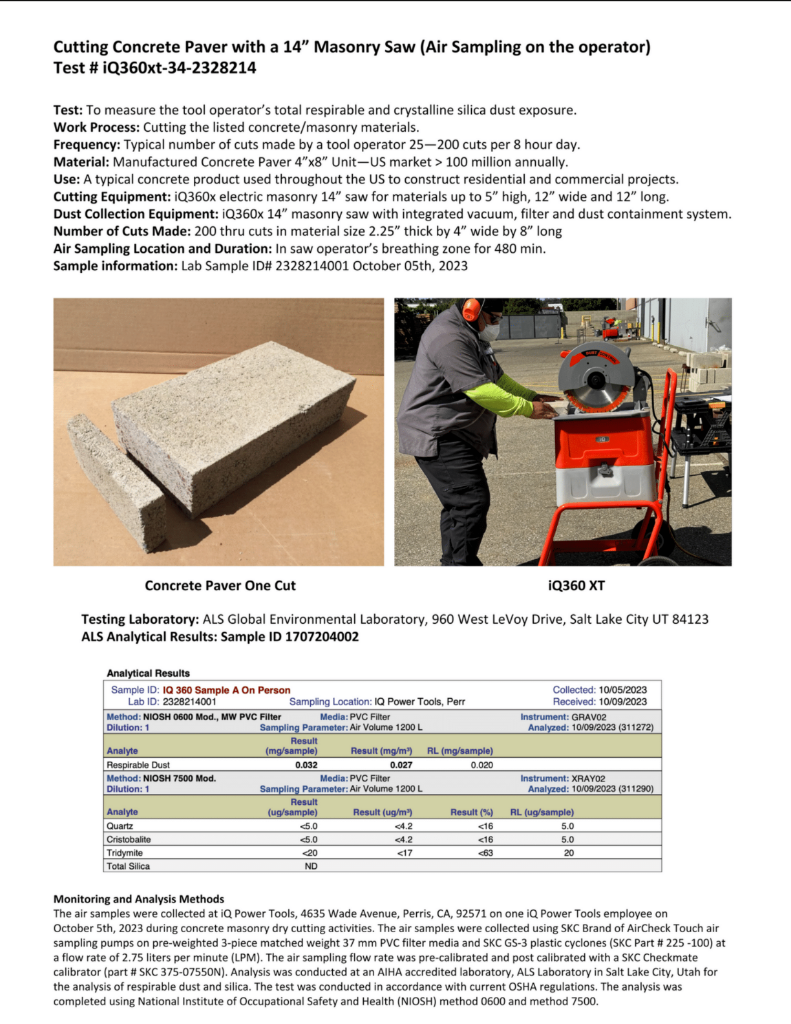
Analytical Results
IQ 360 Sample A — On Person (Breathing Zone)
Lab ID: 2328214001 · Collected: 10/05/2023 · Perris, CA
NIOSH 0600 — Respirable Dust
mg/sample
0.032
mg/m³
0.027
Reporting Limit
0.020
NIOSH 7500 — Crystalline Silica
| Analyte | Result (ug/m³) | Result (%) |
|---|---|---|
| Quartz | <4.2 | <16 |
| Cristobalite | <4.2 | <16 |
| Tridymite | <17 | <63 |
| Total Silica | ND | — |
Monitoring and Analysis Methods
Air samples were collected at iQ Power Tools, 4635 Wade Avenue, Perris, CA, 92571 during dry cutting activities. Samples used SKC Brand of AirCheck Touch air sampling pumps on pre-weighted 3-piece matched weight 37 mm PVC filter media and SKC GS-3 plastic cyclones (SKC Part #225-100) at a flow rate of 2.75 liters per minute (LPM). Analysis was conducted at an AIHA accredited laboratory, ALS Laboratory in Salt Lake City, Utah, in accordance with current OSHA regulations using NIOSH method 0600 and method 7500.
Result: Total Silica Not Detected
The iQ360XT produced zero detectable crystalline silica cutting concrete pavers across 200 cuts in an 8-hour simulation. The integrated dust containment system fully captured all respirable silica, confirming OSHA Table 1 compliance without water or slurry.
Disclaimer: iQ Power Tools dry-cut masonry saws are not specifically listed under OSHA Table 1. However, independent air monitoring conducted by ALS Global Environmental Laboratory demonstrates operator respirable crystalline silica exposures substantially below OSHA's 50 µg/m³ Permissible Exposure Limit when the saws are operated with their integrated dust collection systems as intended. Therefore, employers may use the objective data and exposure assessment provisions of OSHA 29 CFR 1926.1153 to support silica compliance. Results may vary based on material type, cutting conditions, and equipment maintenance.