OSHA Silica Dust Rules for Tile Setters: What You Need to Know in 2026
Silica Dust Is a Serious Health Risk
Respirable crystalline silica is generated whenever you cut, grind, or drill into materials that contain silica — including porcelain tile, ceramic tile, concrete, and natural stone. Fine silica particles can penetrate deep into the lungs, causing silicosis, lung cancer, and COPD with long-term exposure.
OSHA's Respirable Crystalline Silica Standard (29 CFR 1926.1153) sets a Permissible Exposure Limit (PEL) of 50 μg/m³ as an 8-hour TWA — and an Action Level of 25 μg/m³.
What Is OSHA Table 1?
Table 1 is a list of common construction tasks with specified engineering controls and work practices that, when followed, are presumed to keep worker exposure below the PEL. If a task is on Table 1 and you use the listed controls, you're compliant — no air monitoring required.
For tile and stone cutting, Table 1 specifies:
- Operate and maintain a wet saw, OR
- Use a saw with integrated water delivery that continuously feeds water to the blade, OR
- Use a dry-cutting saw equipped with a HEPA dust collection system
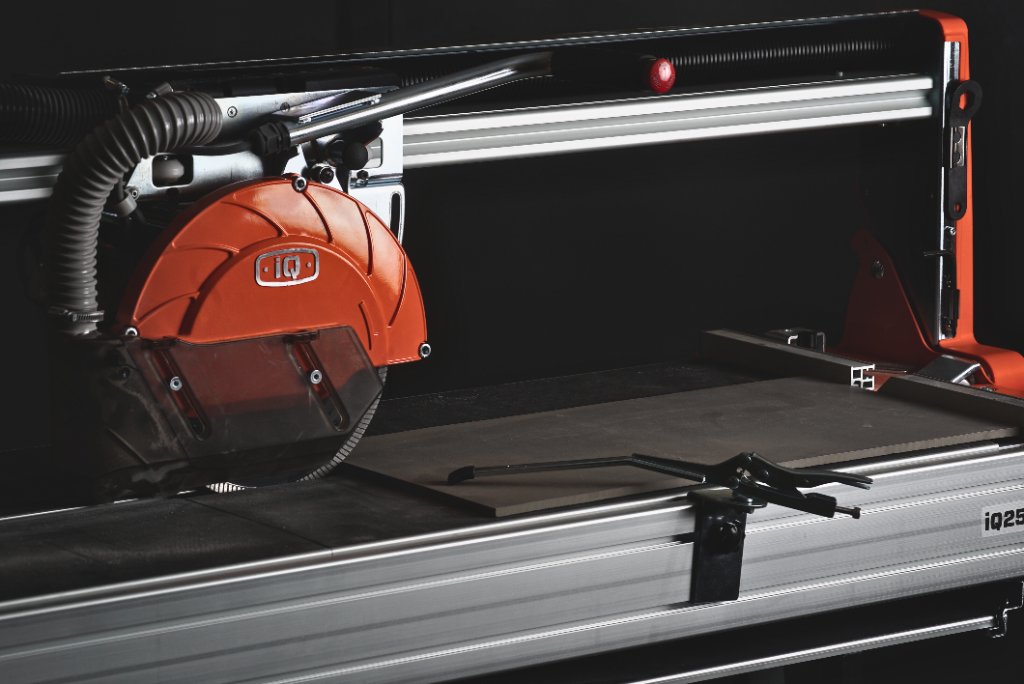
iQ Power Tools saws qualify under the third option — integrated dust collection at the source.
How iQ Saws Meet Table 1
iQ saws are not specifically enumerated in Table 1, but employers can use objective data and exposure assessment under 29 CFR 1926.1153 to demonstrate compliance. Independent air monitoring by ALS Global Environmental Laboratory shows iQ saw operators measure substantially below the 50 μg/m³ PEL during normal cutting operations.
This means you can present that data to OSHA inspectors as evidence of compliance — no wet cutting required.
Penalties for Non-Compliance
- Serious violation: Up to $16,550 per violation
- Willful or repeated violation: Up to $165,514 per violation
- Failure to abate: Up to $16,550 per day beyond the correction deadline
Practical Compliance for Tile Setters
- Use an iQ saw with integrated dust collection for all tile cutting.
- Keep the dust chamber maintained — a full chamber reduces capture efficiency.
- Document your equipment — keep spec sheets and ALS monitoring data on file.
- Train your crew — all workers in the silica exposure zone need silica awareness training.
- Establish a Written Exposure Control Plan — required if exposure may reach the action level.
Bottom Line
OSHA silica compliance isn't optional — and it's not as complicated as it sounds when you have the right equipment. iQ saws let tile setters cut dry, cut clean, and stay compliant on every job.